Professional Mold Remediation in West Columbia, South Carolina
West Columbia sits adjacent to the Congaree River and shares a municipal boundary with Columbia while maintaining its own distinct neighborhoods, aging commercial corridors, and housing stock that spans from pre-WWII bungalows to post-2000 infill development. Proximity to the river, older drainage infrastructure, and Columbia's urban heat island create persistent mold risk across the community. Edmondson Restoration deploys from Columbia in under 20 minutes for IICRC S520-certified mold remediation.
 Veteran Owned
 IICRC Certified
Suspect Mold? Here's What to Do Right Now
If you've found mold in your West Columbia property, take these steps before our team arrives.
✓ DO These Things
- 1.Call us at 888-742-3085 to schedule a professional mold inspection
- 2.Avoid disturbing the mold — agitation releases spores into the air
- 3.Increase ventilation in the affected area if possible (open windows)
- 4.Keep HVAC off in the affected area to prevent spreading spores
- 5.Document visible mold with photos for insurance purposes
✗ DON'T Do These Things
- 1.Don't try to clean mold yourself — improper cleanup spreads contamination
- 2.Don't use bleach on mold — it doesn't kill mold on porous surfaces and creates toxic fumes
- 3.Don't paint over mold — it grows right through paint
- 4.Don't ignore musty smells — hidden mold may be behind walls or under flooring
- 5.Don't delay action — mold spreads rapidly and health risks increase with exposure
Our Mold Remediation Process
Professional Mold Inspection
Our certified technicians perform a comprehensive inspection using moisture meters, thermal imaging, and visual assessment to identify all mold-affected areas.
Mold Testing & Lab Analysis
Air quality and surface samples are collected and sent to an independent lab. Results identify mold species, concentration levels, and guide our remediation approach.
Containment & Air Filtration
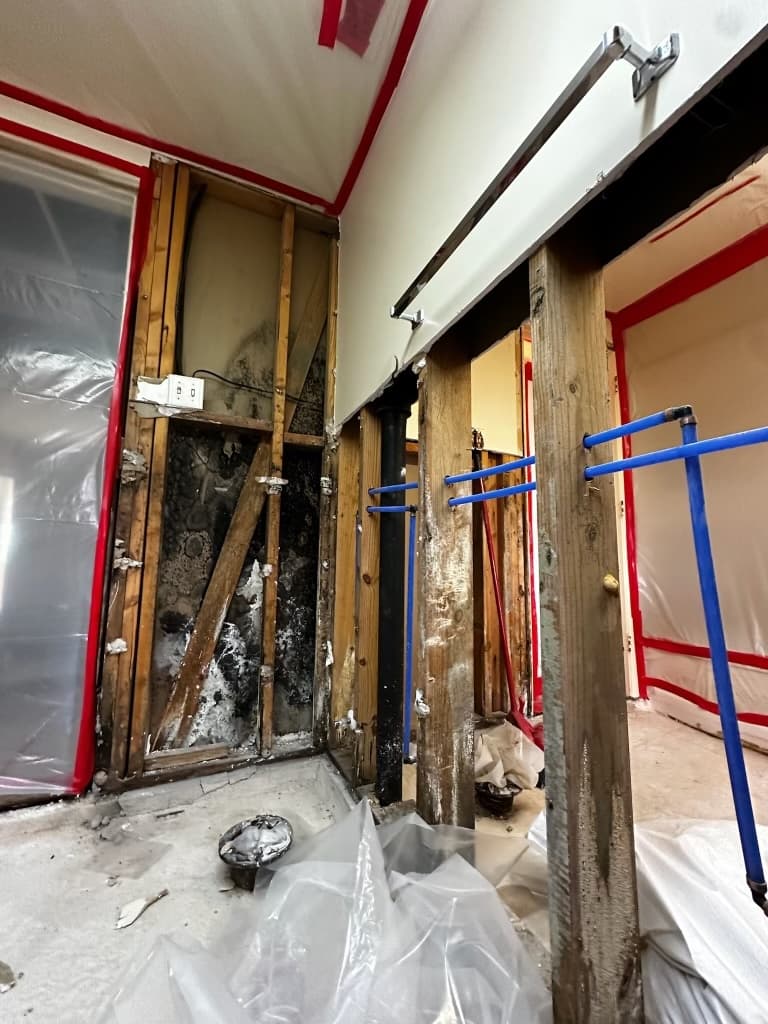
We isolate affected areas with plastic sheeting and negative air pressure to prevent spore spread. HEPA air scrubbers filter airborne mold spores continuously.
Mold Removal & Treatment
Mold-affected materials are carefully removed following IICRC protocols. Remaining surfaces are treated with professional-grade antimicrobial solutions.
Cleaning & HEPA Vacuuming
All surfaces in the contained area are thoroughly cleaned and HEPA vacuumed. Air quality testing confirms successful remediation.
Restoration & Prevention
We repair or replace removed materials and address the moisture source that caused mold growth to prevent recurrence.
Why West Columbia Homeowners Choose Edmondson for Mold Remediation
Veteran Owned & Operated
Military thoroughness ensures every trace of mold is found and eliminated. We don't cut corners on your family's health.
Professional Testing
Independent lab testing identifies mold species and concentration. We don't guess — we verify with science.
Local & Independent
Not a franchise. A local business that understands Congaree River area flooding history, West Columbia's older neighborhood stock, and Lexington County moisture conditions.
Insurance Assistance
We document mold damage thoroughly and work with your insurance company to maximize your coverage.
IICRC S520 Standard
We follow the IICRC S520 mold remediation protocol, the industry's gold standard. Our technicians are specifically trained and certified in mold, not just generally IICRC certified.
Remediation Through Rebuild
Unlike mold-only specialty firms, we handle inspection, removal, and full reconstruction in-house. One team from start to finish, no coordination delays, no subcontractors.
Don't Let Mold Affect Your Family's Health
West Columbia's Congaree River proximity creates persistent mold risk. Call now for professional inspection and remediation.
Common Causes of Mold in West Columbia, SC
West Columbia's Congaree River proximity, aging housing stock, and older drainage infrastructure create above-average mold risk throughout the community.
Congaree River Floodplain Residual Moisture
West Columbia's lower-lying neighborhoods adjacent to the Congaree River and Gills Creek have experienced significant flooding events in recent years, including major losses in October 2015 and continuing risk during major rainfall events. Properties that experienced flooding often have residual moisture in crawl spaces, below-grade areas, and wall cavities that was never professionally remediated. This long-term moisture provides conditions for mold growth that continues years after the original flood event.
Aging Housing Stock and Original Construction
West Columbia's established residential neighborhoods contain a high concentration of homes built between 1930 and 1970 with construction methods that lack modern vapor control. Original plaster walls on wood lath, single-layer brick veneer, and crawl space foundations without vapor barriers are common in neighborhoods like Airport Hills, Platt Springs, and the South Carolina 302 corridor. These assemblies accumulate moisture from both outdoor humidity and indoor activities in ways that modern construction does not.
Older Storm Water Infrastructure
West Columbia's drainage infrastructure in older neighborhoods was designed for earlier-era rainfall intensities. Modern storm patterns, including the more intense rainfall events that have become more frequent in the Midlands, overwhelm older storm drains and swales, sending water against foundations and into crawl spaces in neighborhoods where drainage systems haven't been updated. Recurring minor flooding events create persistent crawl space moisture that leads to mold even without a major flood event.
Commercial-to-Residential Property Transitions
West Columbia's Augusta Road and Sunset Boulevard corridors include properties that have transitioned from commercial to residential use over decades. These converted structures often have building assemblies designed for commercial occupancy without the moisture management requirements of residential HVAC systems, and they carry unaddressed moisture intrusion histories from periods of deferred commercial maintenance that create ongoing mold problems for new residential occupants.
Adjacent Columbia Urban Heat Effects
West Columbia's position adjacent to Columbia's urban core means the area experiences urban heat island effects that elevate both outdoor temperatures and relative humidity compared to outlying Midlands communities. Higher ambient temperatures increase the rate of moisture evaporation into indoor air during warm months, and properties with air conditioning systems that don't adequately dehumidify accumulate elevated indoor humidity that creates baseline mold conditions.
Mold Remediation Coverage — West Columbia and Lexington County
Our Columbia office serves West Columbia, Cayce, and all nearby Lexington County communities. Call for same-day assessment. Call 888-742-3085
Mold Remediation FAQ — West Columbia, SC
How do I know if I have mold in my West Columbia home?
Is mold testing necessary before remediation?
How long does mold remediation take?
Is mold remediation covered by insurance?
Can I stay in my home during mold remediation?
How do you prevent mold from coming back?
How much does mold remediation cost in West Columbia, SC?
Request Mold Remediation Service in West Columbia
Fill out the form and our team will contact you immediately. For the fastest response, call us directly.
✓ Free damage assessment
✓ Insurance claims assistance
✓ On-site in under 1 hour
✓ IICRC certified technicians
Mold in Your West Columbia Home? Call Now.
IICRC S520-certified remediation. Under 20 minutes from our Columbia office. Veteran-owned. Call 888-742-3085.